Learning Conservative Neural Control Barrier Functions from Offline Data
Contact:
{i.k.tabbara, sibai}@wustl.edu
Abstract
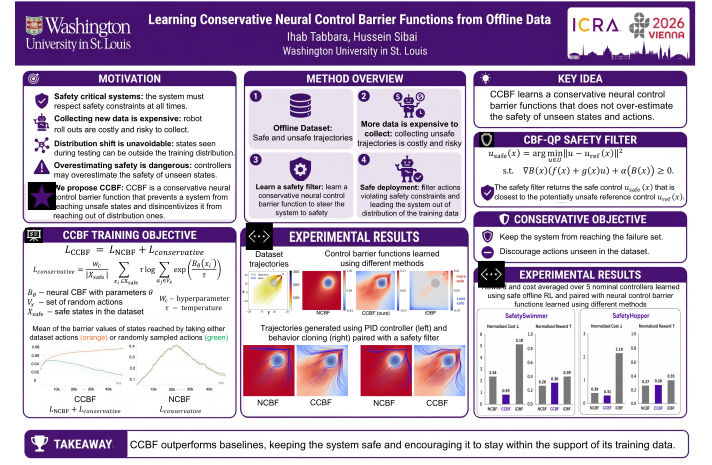
Safety filters, particularly those based on control barrier functions, have gained increased interest as effective tools for safe control of dynamical systems. Existing correct-by-construction synthesis algorithms for such filters, however, suffer from the curse-of-dimensionality. Deep learning approaches have been proposed in recent years to address this challenge. In this paper, we add to this set of approaches an algorithm for training neural control barrier functions from offline datasets. Such functions can be used to design constraints for quadratic programs that are then used as safety filters. Our algorithm trains these functions so that the system is not only prevented from reaching unsafe states but is also disincentivized from reaching out-of-distribution ones, at which they would be less reliable. It is inspired by Conservative Q-learning, an offline reinforcement learning algorithm. We call its outputs Conservative Control Barrier Functions (CCBFs). Our empirical results demonstrate that CCBFs outperform existing methods in maintaining safety while minimally affecting task performance.Key contributions
- Conservative Control Barrier Functions learn neural safety filters from offline datasets.
- A Conservative Q-learning-inspired objective disincentivizes the system from entering out-of-distribution states where the learned barrier is less reliable.
- The learned barrier defines a quadratic-program safety filter that improves empirical safety while minimally affecting task performance.
Poster
Citation
@misc{tabbara2025learningconservativeneuralcontrol,
  title={Learning Conservative Neural Control Barrier Functions from Offline Data},
  author={Ihab Tabbara and Hussein Sibai},
  year={2025},
  eprint={2505.00908},
  archivePrefix={arXiv},
  primaryClass={cs.LG},
  url={https://arxiv.org/abs/2505.00908},
}